Emerson · Rosemount
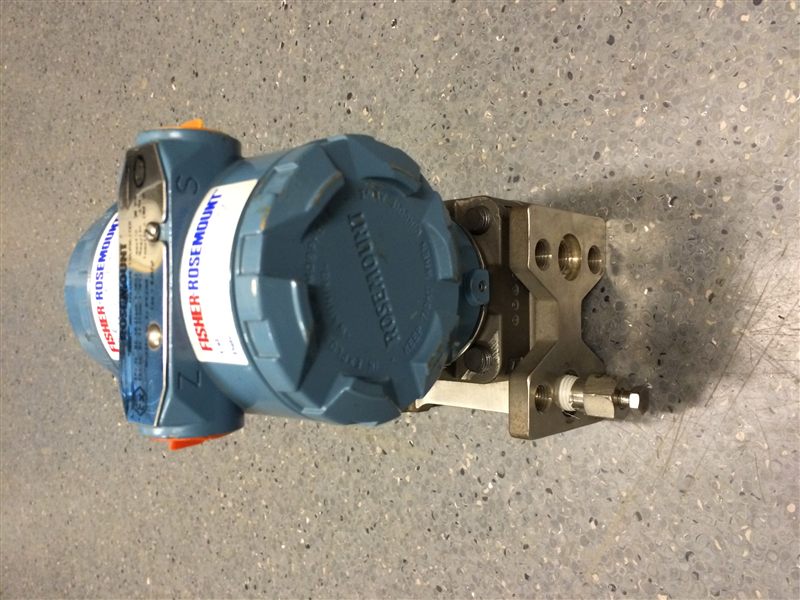
Rosemount 3051 Pressure Transmitter
The world's best-selling pressure transmitter — a differential, gauge, and absolute pressure measurement workhorse delivering 0.04% accuracy with HART, Foundation Fieldbus, and WirelessHART output options for process industries worldwide.
Overview
The Emerson Rosemount 3051 is arguably the most widely deployed pressure transmitter in industrial history, with millions of units installed across oil & gas, chemical, power, refining, and water treatment processes worldwide. First introduced in the 1980s and continuously updated, the 3051 established the standard for the modern 4-20 mA smart transmitter by combining excellent accuracy, long-term stability, and comprehensive diagnostics in a ruggedised process-grade housing.
The 3051 product line covers differential pressure (3051C), gauge pressure (3051T), and absolute pressure (3051T and 3051CA) measurement with a coplanar flange design that accepts remote seals, manifolds, and diaphragm seals without special adaptors. HART 5 and HART 7 communication overlay digital information on the 4-20 mA loop — enabling remote configuration, diagnostics, and secondary variable transmission (static pressure, temperature) without additional wiring.
The 3051S Scalable Pressure Transmitter variant (the "S" series) uses a modular electronics/sensor design with improved 0.025% accuracy and 15-year stability specification. WirelessHART variants (3051S with WirelessHART head) allow deployment in locations where running signal cable is cost-prohibitive, transmitting at 2.4 GHz using the WirelessHART mesh network protocol (IEC 62591).
Key Features
- 0.04% reference accuracy, ±0.1%/10-year stabilityThe 3051's accuracy specification of ±0.04% of calibrated span across the full operating range is among the best in class for industrial pressure transmitters. The long-term stability of ±0.1% over 10 years significantly reduces calibration frequency requirements, lowering maintenance costs in large installations.
- HART 5/7 with secondary variable outputHART communication allows remote zero/span adjustment, diagnostic reads (sensor temperature, electronics temperature, loop current), and secondary variable transmission (static line pressure on DP units) over the same two-wire 4-20 mA loop. No additional wiring or input channels are required to monitor secondary variables.
- SIL 2 rated for safety instrumented systemsThe Rosemount 3051 is certified to SIL 2 (with achievable SIL 3 in redundant configurations) per IEC 61508, making it suitable for use in Safety Instrumented Systems (SIS) as a pressure sensing element. The SIL certification includes PFD (Probability of Failure on Demand) data for use in SIL calculation tools like EXIDA exSILentia.
- Coplanar flange with manifold compatibilityThe coplanar flange accepts direct-mount 2-valve, 3-valve, and 5-valve manifolds without adaptors, reducing leak points and enabling inline zero calibration without process isolation. Remote seal assemblies extend measurement to high-temperature, viscous, or corrosive fluids that cannot contact the process flange directly.
- Advanced diagnostics — plugged impulse line detectionEmerson's statistical process monitoring (SPM) algorithm embedded in the 3051S monitors measurement noise patterns to detect plugged or blocked impulse lines — a common failure mode in slurry and viscous service that is invisible to standard 4-20 mA measurement. This enables condition-based maintenance rather than time-based inspection schedules.
Technical Specifications
| Measurement types | Differential (3051C), Gauge (3051T), Absolute (3051T/CA) |
|---|---|
| Reference accuracy | ±0.04% of calibrated span (3051); ±0.025% (3051S) |
| DP ranges | 0.1 inH₂O to 2,000 psi (24 mbar to 138 bar) |
| Output signal | 4–20 mA with HART 5 or 7; optional Foundation Fieldbus or WirelessHART |
| Supply voltage | 10.5–42.4 V DC (HART); 9–32 V DC (Foundation Fieldbus) |
| Wetted materials | 316L SS, Hastelloy C-276, Tantalum, Gold-plated SS |
| Process temp (fluid) | −40 °C to +121 °C; −40 °C to +232 °C with remote seals |
| Ambient temp rating | −40 °C to +85 °C |
| Overpressure limit | Up to 2,000 psi (138 bar) depending on range |
| Process connections | Coplanar flange: ¼–18 NPT or IEC 61518 flange |
| Enclosure rating | IP66/67, NEMA 4X |
| Certifications | ATEX Ga/Gb, IECEx, CSA, FM; SIL 2 (IEC 61508) |
| Stability | ±0.1% URL per 10 years (3051); ±0.1% URL per 15 years (3051S) |
Typical Applications
- Flow measurement (DP method): Measuring differential across orifice plates, venturi tubes, and averaging pitot tubes for gas and liquid flow
- Tank level: Differential pressure across submersible or flanged DP tap for open and closed vessel level
- Pump/compressor monitoring: Differential pressure across suction/discharge for condition monitoring and efficiency calculations
- Safety instrumented systems: SIL 2 rated overpressure detection in high-integrity protection systems (HIPS)
- Filter differential monitoring: Tracking filter clogging across heat exchangers, strainers, and particulate filters
Sources & Further Reading
- Emerson — Rosemount 3051 Product Data Sheet (00813-0100-4001)
- HART Communication Foundation — HART 7 Specification
- IEC 61508:2010 — Functional Safety of Electrical/Electronic/Programmable Electronic Safety-related Systems
- IEC 62591:2016 — WirelessHART Specification
- ISA-75.01.01 — Flow Equations for Sizing Control Valves